A tandem project of Prof. Siegfried Waldvogel (MPI for Chemical Energy Conversion) and Prof. Bettina Lotsch (MPI for Solid State Research).
About
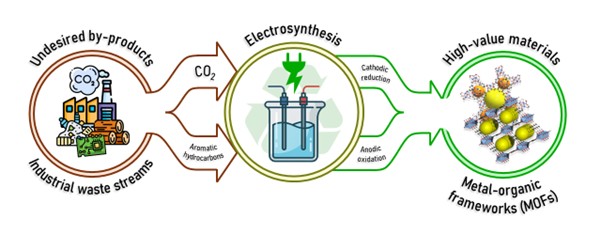
Carbon and metal waste streams are precious resources that can be transformed into high-value porous materials—metals organic frameworks (MOFs)—using only electricity and water. By exploring sustainable electrosynthesis routes of MOFs and their precursors from industrial waste streams, we aim at advancing both innovative circular-materials manufacturing and sustainable, scalable MOF synthesis.
Persons
- Prof. Dr. Siegfried R. Waldvogel (Director @ MPI for Chemical Energy Conversion, Electrosynthesis Department)
- Dr. Mattis-Ole Schmotz (Postdoctoral Researcher @ MPI for Chemical Energy Conversion, Electrosynthesis Department)
- Prof. Dr. Bettina V. Lotsch (Director @MPI for Solid State Research, Nanochemistry Department)
- Dr. Rajesh Das (Postdoctoral Researcher @ MPI for Solid State Research, Nanochemistry Department)
- Dr. Borja Ortín Rubio (Postdoctoral Researcher @ MPI for Solid State Research, Nanochemistry Department)
Project summary
Metal–organic frameworks (MOFs) are crystalline, porous materials that have transformed fields ranging from catalysis and gas storage to environmental remediation—achievements that culminated in the 2025 Nobel Prize in Chemistry. However, their synthesis still relies heavily on petrochemically derived organic linkers and refined metal salts, posing both environmental and economic challenges. In contrast, carbon-containing industrial waste streams—such as CO₂-rich off-gases, plastic waste, biomass hydrolysates, and aromatic residues from pulp or petrochemical industries—represent abundant, renewable sources of carbon that could be transformed into MOF linkers. Electrosynthesis provides a uniquely sustainable way to valorize these streams. Using anodic metal dissolution for generating framework nodes enables precise control over redox and reaction kinetics while using only electricity and water as the driving force. This principle can be extended to waste-derived carbon feedstocks and therefore close the loop between CO₂ emissions, organic waste, and functional materials production. Typically, biogenic and industrial residues are incinerated and thus lose their carbon value. Through electrocatalytic oxidation and reduction, these streams could yield high-value MOF linkers. Integrating such processes would not only replace fossil feedstocks but also decarbonize material synthesis itself, leveraging renewable electricity as the sole energy input.
The aim of the project is to elucidate the MOF nucleation, polymorphism, and stability under electrosynthetic conditions and to develop predictive models linking redox potential, pH, and ligand feed to MOF phase formation, including new possible multivariate frameworks or topologies. This will eventually materialize into a self-contained, carbon-neutral MOF production loop.