A tandem project of Dr. Constanze Neumann (MPI für Kohlenforschung) and Prof. Dierk Raabe (MPI for Sustainable Materials).
About
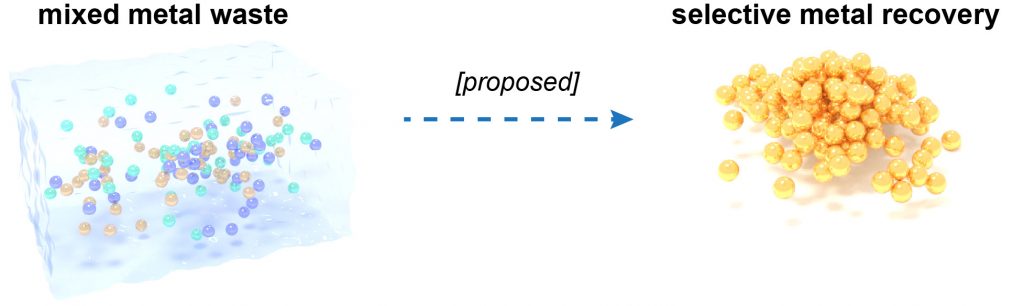
Electronic waste contains many valuable metals in higher amounts than the ores currently used to source them. But since a large variety of metals is present in waste, it is extremely challenging to find financially viable approaches to recover them. RECOVERMOF will use reversible MOF formation to recover valuable metals from waste with minimal CO2 generation.
Persons
- Dr. Constanze Neumann (Lise-Meitner Group Leader @ Max-Planck-Institut für Kohlenforschung, Heterogeneous Catalysis Department)
- Prof. Dierk Raabe (Director @ MPI for Sustainable Materials, Microstructure Physics and Alloy Design Department)
- Dr. Aamir Abbas (Postdoctoral Researcher @ Max-Planck-Institut für Kohlenforschung, Heterogeneous Catalysis Department)
Project summary
The extraction of metals from minerals is a highly resource- and CO2-intensive process, which should be replaced to the greatest extent possible by the recovery of valuable metal precursors from waste streams. A cell phone, for example, contains up to Al (24 wt%), Fe (14 wt%), Cu (6 wt%) and Co (5 wt%), in addition to 340 mg Ag, 34 mg Au and 15 mg Pt, which makes it richer in metal content than any naturally occurring metal ore (except for Fe and Al). Since dismantling of the cell phone cases is readily achievable, counting only the valuable metals and semiconductors in the interior functional parts yields even much higher fractions of the valuable elements. However, because most of the economic value of such electronic waste lies in the noble metals that are present in highly dispersed form and miniscule concentrations, the development of financially viable approaches to source these crucial metals and semiconductors from waste are challenging to develop. As a new and disruptive approach to this challenge we propose here to rely on the reversible formation of metal-organic-framework particles (MOFs) for the recovery of high-value metal resources from recalcitrant waste.