A tandem project of Dr. Florian Hartmann (MPI for Intelligent Systems) and Dr. Tobias Priemel (MPI of Colloids and Interfaces).
About
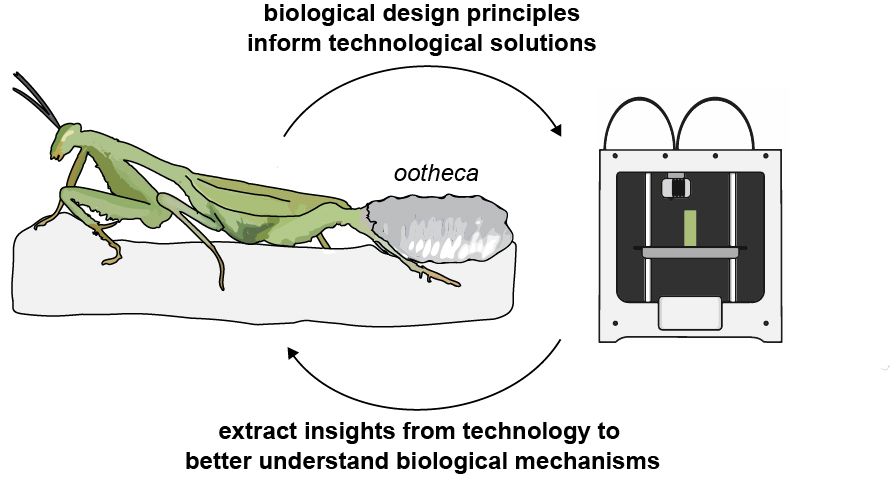
Inspired by the egg case of the praying mantis, this project translates nature’s low-energy fabrication strategies into sustainable 3D printing. We aim to combine recombinant proteins, bioinspired crosslinking, and additive manufacturing to create stiff, tough, and fully biodegradable protein-based materials as alternatives to conventional commodity plastics.
Persons
- Dr. Florian Hartmann (Max Planck Research Group Leader @ MPI for Intelligent Systems, Biomimetic Materials and Machines Group)
- Dr. Tobias Priemel (Postdoctoral Researcher @ MPI of Colloids and Interfaces, Sustainable and Bio-inspired Materials Department)
Project summary
Conventional plastics play a central role in modern society due to their versatility and favorable mechanical properties, yet their production and end-of-life management are associated with high energy demands and persistent environmental pollution. In contrast, biological systems routinely fabricate high-performance materials under ambient conditions using renewable building blocks that biodegrade after use. A striking example is the egg case (ootheca) of the praying mantis, a lightweight yet mechanically robust structure produced through a process analogous to additive manufacturing. Despite being primarily protein-based, the ootheca exhibits exceptional stiffness, toughness, and durability, which arise from its hierarchical architecture and catechol-mediated crosslinking chemistry.
This project aims to elucidate the biological production process of the praying mantis ootheca and translate its key principles into a sustainable 3D printing platform for protein-based materials. By combining protein engineering, bioinspired chemistry, and process design, this project seeks to establish a modular framework for the fabrication of functional protein materials with tunable mechanical properties and environmental compatibility. The outcomes are expected to provide fundamental insights into nature-derived manufacturing strategies and to advance sustainable alternatives to conventional hard plastics with potential for scalable production.