A tandem project of Dr. Uladzimir Barayeu and Dr. David Ng (MPI for Polymer Research) and Prof. Dr. Peer Fischer (MPI for Medical Research).
About/Topic
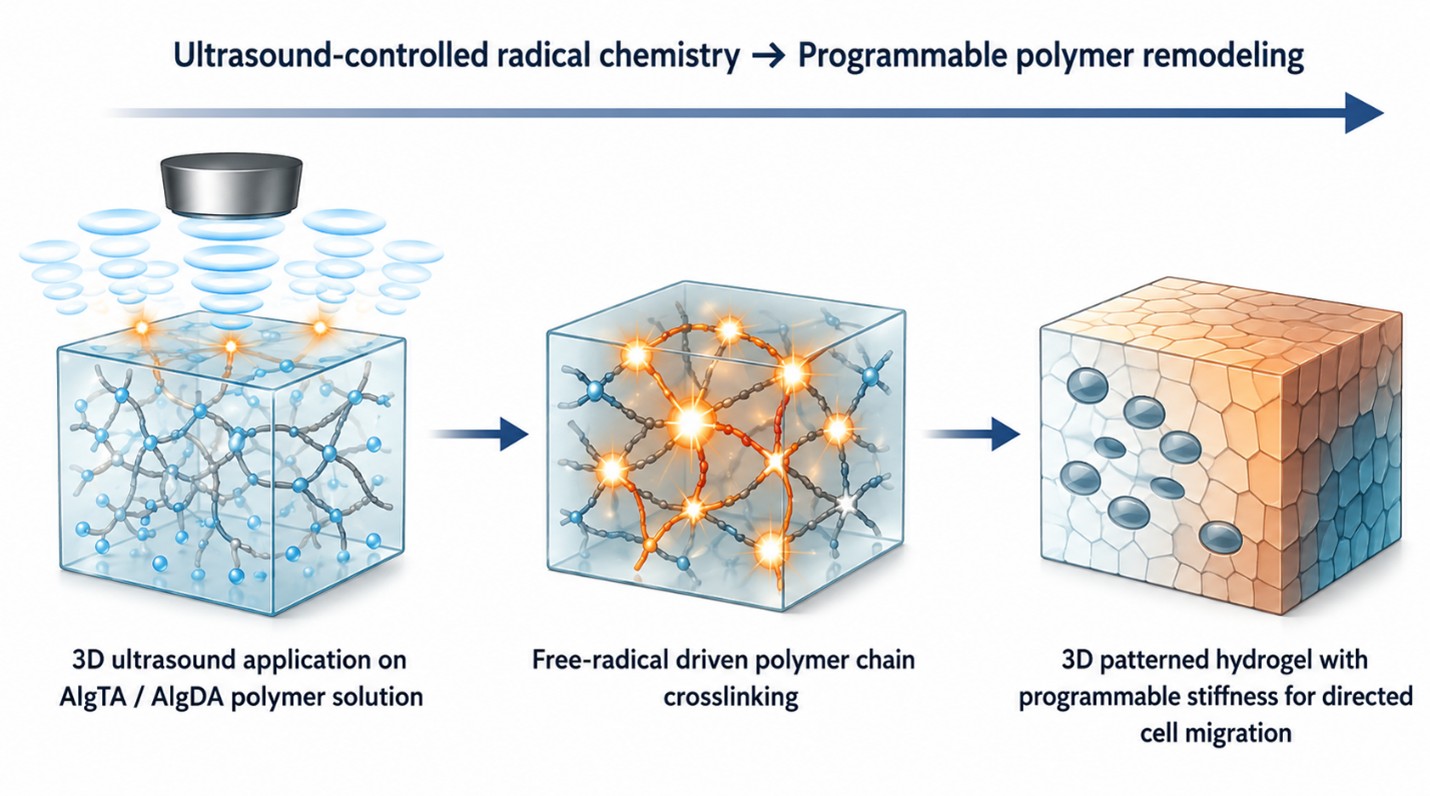
Synthetic polymers are everywhere, but they are usually designed to be either strong and long-lasting or degradable, rarely both. Radius explores a new way to control polymer materials on demand: using focused ultrasound to trigger radical chemistry inside soft polymer networks. Inspired by nature’s stress-responsive materials, the project aims to locally reinforce, remodel, or break down hydrogels without touching them.
By combining ultrasound-guided radical generation with biodegradable alginate-based polymers, Radius seeks to “write” mechanical patterns into materials in 3D and in real time. This could enable adaptive cell scaffolds, longer-lasting yet recyclable materials, and new routes toward sustainable, programmable polymer systems.
Persons
- PI: Dr. Uladzimir Barayeu (W2 Group Leader @ MPI for Polymer Research, Biomolecular Mechanics Department)
- PI: Dr. David Ng (Group Leader @ MPI for Polymer Research, Synthesis of Macromolecules Department)
- PI: Prof. Dr. Peer Fischer (Research Group Leader @ MPI for Medical Research, Micro Nano and Molecular Systems Lab)
- Marius Braun (PhD student @ MPI for Polymer Research, Synthesis of Macromolecules Department)
- Dr. Lovish Gulati (Postdoctoral Researcher @ MPI for Medical Research, Micro Nano and Molecular Systems Lab)
- Mareike Stoll (MSc Student @ MPI for Medical Research, Micro Nano and Molecular Systems Lab)
Project summary
Synthetic polymers underpin modern infrastructure, healthcare, and manufacturing, yet their sustainability remains a central unresolved challenge. Materials are typically designed for either durability or degradability, but rarely for both. Achieving dynamic control over polymer stability materials when needed and triggering degradation on demand would represent a transformative advance toward circular material design. Here, we propose a fundamentally new approach that enables both processes in a contact-free and externally programmable manner.
Radius addresses this challenge through radical chemistry. Recent work from Barayeu has shown that collagen, nature’s primary load-bearing polymer, does not passively accumulate damage under mechanical stress but actively responds to it. Mechanical stress-induced covalent bond scission generates radicals that migrate to aromatic residues and form stabilised tyrosyl radicals, which recombine into di-tyrosine crosslinks, reinforcing the material locally (Kurtz, Barayeu et al., Angew. Chem. Int. Ed. 2023). In parallel, the Ng group has developed a fully synthetic analogue: tyramine-functionalised alginate (AlgTA) polymers, which undergo di-tyrosine crosslinking under chemical oxidation to form hydrogels.
Together, these findings raise a key design question: can mechanoradical chemistry operate in synthetic materials to achieve programmable 3-D engineering over their mechanical properties?
Radius introduces focused ultrasound as such a trigger. Ultrasound can generate radicals via sonolysis of water or polymer bond scission, while offering non-invasive, deeply penetrating, and spatially programmable energy delivery. The Fischer group at the Max Planck Institute for Medical Research provides a unique platform for precisely controlled acoustic fields, enabling targeted radical generation within soft materials.