A tandem project of Prof. Dr. Petra Schwille (MPI of Biochemistry) and Prof. Dr. Rumiana Dimova (MPI of Colloids and Interfaces).
About/Topic
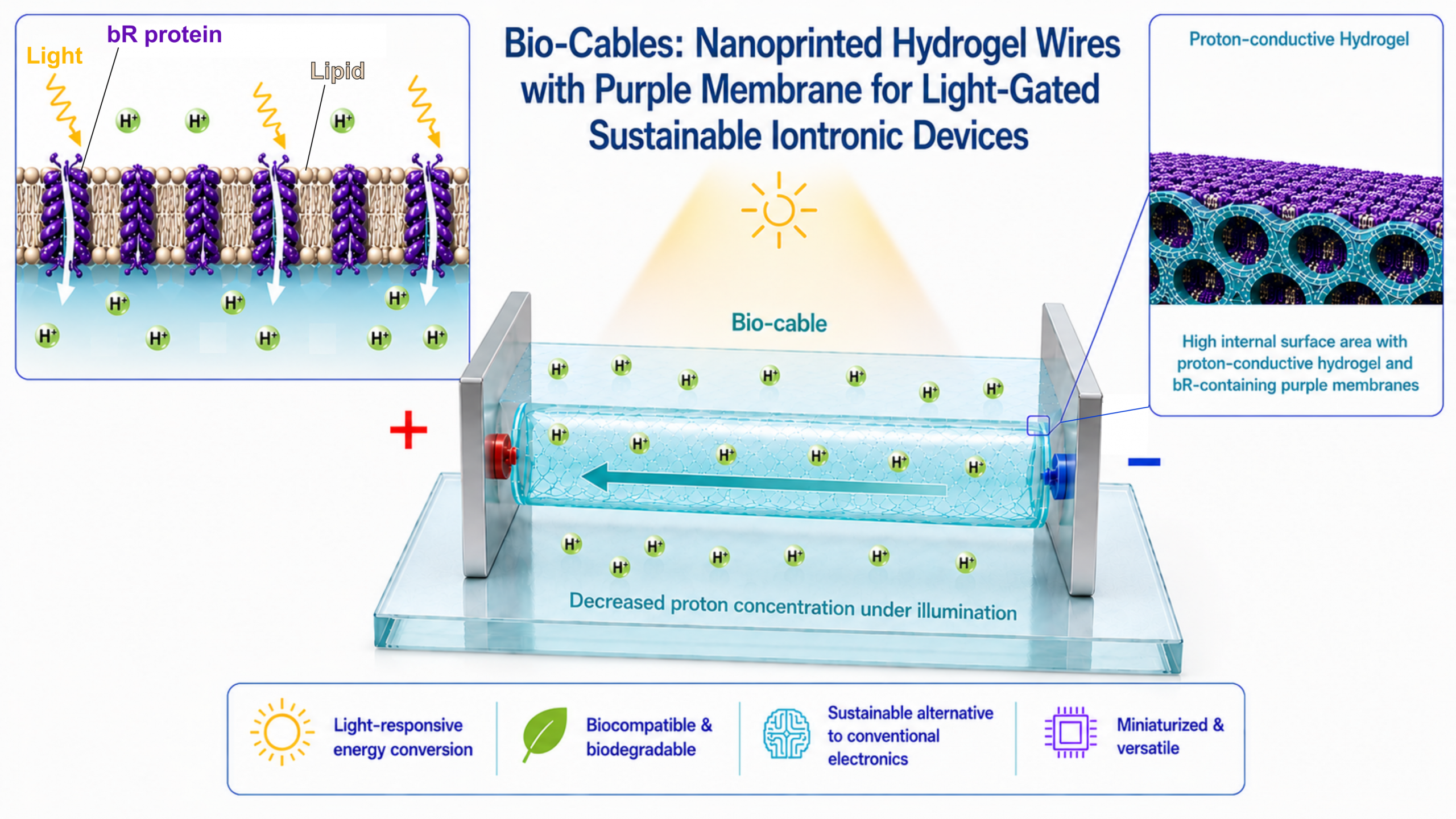
Every nerve impulse in your body is carried by ions, not electrons and evolution has refined this process to be fast, efficient, and built entirely from biodegradable materials. Bio-Cable takes inspiration from this principle: we use bacteriorhodopsin, a light-harvesting protein found in microbes, to build micro-wires that switch their ion conductance on and off with light. These biohybrid cables open a path to sustainable, light-controlled devices for sensing and low-power computing.
Persons
- PI: Prof. Dr. Rumiana Dimova (Independent Group Leader, Membrane Biophysics and artificial cells @ MPI of Colloids and Interfaces, Sustainable and Bio-inspired Materials Department)
- PI: Prof. Dr. Petra Schwille (Director @ MPI of Biochemistry, Cellular and Molecular Biophysics Department)
- Dr. Elias Sabri (Postdoctoral Researcher @ MPI of Colloids and Interfaces, Sustainable and Bio-inspired Materials Department)
Project summary
Living nervous systems transduce electrical signals through the controlled flow of ions, not electrons, achieving high-efficiency energy transfer with entirely biodegradable materials. Iontronics, the emerging field that aims to replicate this in man-made devices, has so far relied on synthetic polymers and inorganic materials with significant ecological footprints.
Bio-Cable proposes a fundamentally sustainable approach: integrating bacteriorhodopsin (bR), the photoactive protein pump of the purple membrane (PM) of Halobacterium salinarum into miniaturized hydrogel cables fabricated by Nanoscribe two‑photon polymerization (a 3D laser printing technique with micron resolution). Oriented deposition of PM onto the cable surface ensures that bR pumps protons into the cable under illumination, raising ion concentration inside and modulating ionic current flowing between tow electrodes under applied bias.
The result is a light-gated ionic photoswitch whose conductance responds both digitally (on/off) and in a continuous fashion to light intensity. This opens the door to miniaturized, sustainable, sensing-based materials acting as micro‑energy harvesters offering a biologically inspired alternative to conventional electronic materials.