A tandem project of Prof. Sohini Kar-Narayan (MPI for Dynamics of Complex Technical Systems) and Prof. Xinliang Feng (MPI of Microstructure Physics).
About/Topic
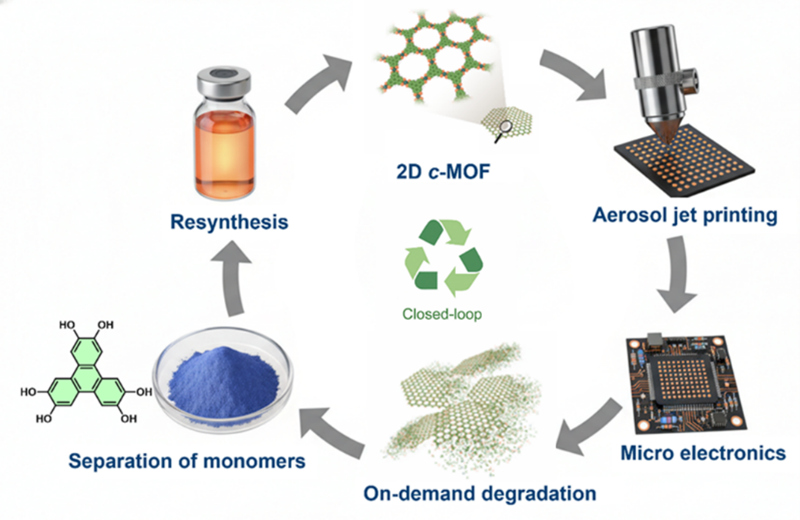
By integrating chemically programmable 2D c-MOFs with high-resolution aerosol jet printing, we establish a new platform for recyclable, digitally manufactured microelectronics.
Persons
- Prof. Sohini Kar-Narayan (Director @ MPI for Dynamics of Complex Technical Systems, Material System and Engineering Department)
- Dr. Argha Chakraborty (Postdoctoral Researcher @ MPI for Dynamics of Complex Technical Systems, Material System and Engineering Department)
- Prof. Xinliang Feng (Director @ MPI for Microstructure Physics, Synthetic Materials and Functional Devices Department)
- Dr. Jianjun Zhang (Postdoctoral Researcher @ MPI for Microstructure Physics, Synthetic Materials and Functional Devices Department)
Project summary
The rapid expansion of the microelectronics industry has intensified electronic waste generation, underscoring the need for sustainable materials and fabrication strategies. Conventional conductive materials, including noble metals, metal oxides, and conductive polymers, are difficult to recycle and rely on energy-intensive processes. This project proposes the integration of two-dimensional conjugated metal–organic frameworks (2D c-MOFs) with aerosol jet printing (AJP) to enable recyclable, low-impact microelectronics.
2D c-MOFs feature tunable electronic properties, structural modularity, and reversible coordination bonds that allow programmable degradation. Our preliminary studies demonstrate that ultrasonic cavitation in alkaline solution selectively cleaves metal–ligand linkages, recovering organic ligands with 96.3% yield and high purity for direct reuse, thereby establishing a closed-loop material lifecycle. However, their practical application is limited by solvothermal synthesis and incompatibility with conventional lithography.
To address this, we propose the development of MOF-based inks for AJP, a maskless, low-temperature, high-resolution printing technique compatible with flexible and non-planar substrates. By combining digital fabrication with chemically recyclable materials, this project aims to establish a framework for recyclable, reconfigurable microelectronics and advance circular manufacturing in next-generation electronic systems.
Related News