A tandem project of Dr. Christopher Synatschke (MPI for Polymer Research), Dr. Wenyang Xu, and Dr. Xiaowen Wu (MPI of Colloids and Interfaces).
About/Topic
Separation technologies are indispensable to modern industry—from purifying drinking water to recovering critical resources. Yet today’s high-performance membranes rely on petroleum-derived materials and energy-intensive manufacturing and are ill suited for recycling. CellDopaMem will develop next-generation materials through a green process using bio-based components to achieve high performance membranes.
Persons
- Dr. Wenyang Xu (Group Leader @ MPI for Colloids and Interfaces, Sustainable and Bio-inspired Materials Department)
- Dr. Xiaowen Wu (Postdoctoral Researcher @ MPI for Colloids and Interfaces, Sustainable and Bio-inspired Materials Department)
- Dr. Christopher Synatschke (Group Leader @ MPI for Polymer Research, Synthesis of Macromolecules Department)
- Dr. Dominik Fuchs (Postdoctoral Researcher @ Max Planck Institute for Polymer Research, Synthesis of Macromolecules Department)
Project summary
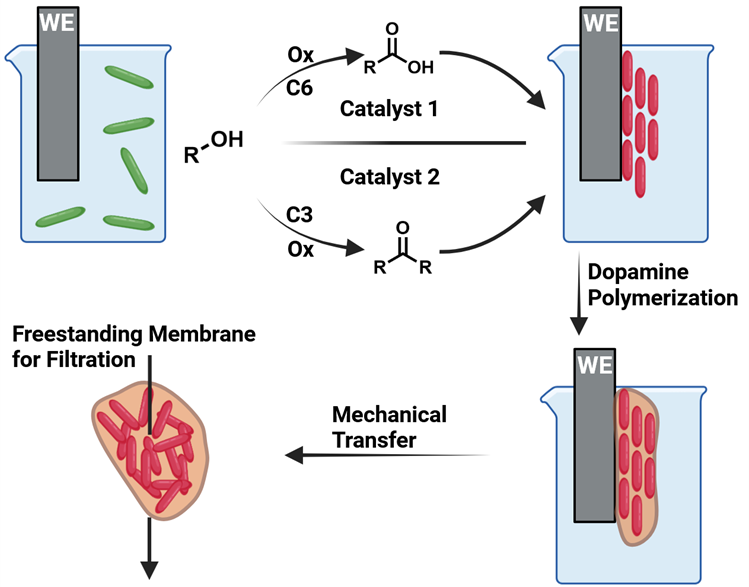
CellDopaMem aims to replace petroleum-based filtration membranes with sustainable, high-performance alternatives made from nanocellulose (a renewable wood-derived material) and polydopamine (a bio-inspired adhesive polymer). Current membranes rely on energy-intensive, polluting processes in their production and are difficult to recycle. This project uses electrochemistry to oxidize cellulose cleanly, assemble it into structured membranes, and reinforce it with dopamine—all in a single, scalable step. The resulting membranes will have tunable pores for precise filtration (e.g., removing heavy metals or recovering lithium) while maintaining high water flow. Unlike conventional membranes, they can be degraded and recycled by dissolving the dopamine under mild conditions, recovering the cellulose scaffold. Potential applications span water purification, critical metal recovery, biomedical separations, and food processing. By combining green chemistry, renewable materials, and electrochemical control, CellDopaMem seeks to create circular, high-performance membranes that reduce environmental impact while meeting industrial demands. The project bridges expertise in cellulose functionalization (MPIKG) and polymer chemistry (MPIP) to pioneer a new class of sustainable separation technologies.